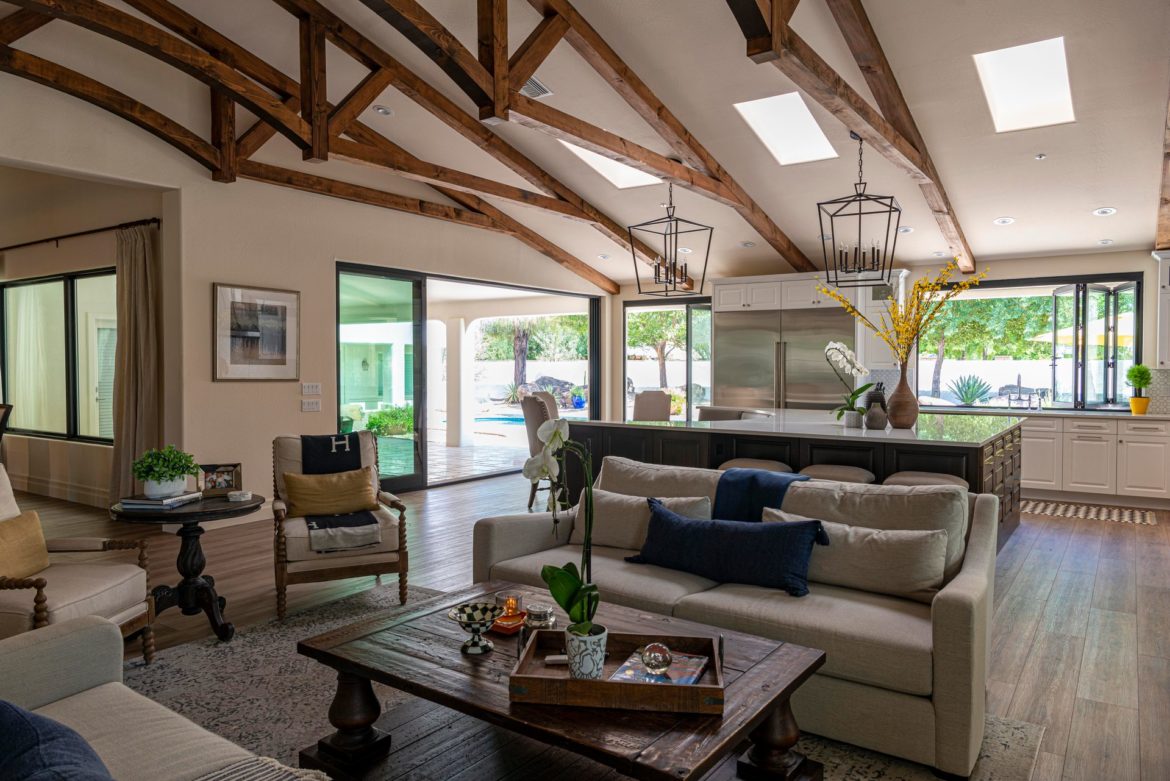
Open plan homes deliver on light and a sense of space, and they have been the dominant residential design preference for the better part of two decades. But the home office that bleeds into the kitchen, the television that competes with the dinner table, and the absence of any quiet corner can all erode what made the layout appealing in the first place. The good news is that dividing an open-plan home does not require demolition or a significant renovation. It requires strategy.
Use rugs to anchor each zone
A well-placed rug is one of the most effective and affordable tools for defining zones within an open plan space. Each distinct area, the seating zone, the dining zone, the reading or work corner, gets its own rug, which immediately signals to the eye that these are separate spaces even where no wall exists. The rugs do not need to match, but they should work together as part of the same overall palette. A rug that is too small for the furniture it anchors will undermine the effect; size up rather than down.
Arrange furniture as soft dividers
The back of a sofa, positioned to face the seating area rather than the kitchen or entrance, creates a natural boundary between the living zone and the space beyond it. A low bookcase or console table positioned perpendicular to the wall performs the same function with more storage. The furniture itself becomes the wall, in effect, without any of the permanence.
A bookcase as a room divider
A freestanding, floor-to-ceiling or near-ceiling bookcase placed between the kitchen and the living area creates a genuine partition with immediate visual impact. It absorbs sound, defines the boundary clearly, and doubles as storage. Styling the shelves with a mix of books, plants and objects on the side facing the living space and more practical items on the side facing the kitchen allows it to feel appropriate to each zone. Open-backed bookcases allow light to pass through; closed-backed ones provide more definition.
Curtain tracks from the ceiling
Floor-to-ceiling curtains hung from a ceiling-mounted track are a remarkably effective way to introduce separation in an open plan space. When open, they disappear entirely and the space reads as one. When drawn, they create a full, soft wall of fabric that muffles sound and provides genuine visual privacy. Linen or a similar heavier weave works better than sheer fabric for this purpose. This is a particularly useful solution for separating a home office or a children’s play area from the rest of the living space without any structural changes.
Pendant lighting to define zones
Lighting is one of the most underused tools in open plan design. A cluster of pendants over the dining table, a statement light fixture above the seating area, and a desk lamp or floor lamp in the work corner each signal a different zone and create different atmospheres within the same space. When the ceiling lights are dimmed and the pendant over the dining table is lit, the table becomes its own room without any physical boundary needing to exist.
Half-walls and knee walls
For a more permanent solution that does not require building a full wall, a knee wall, typically around 90 to 100 centimetres high, separates spaces while maintaining the flow of light and air. These work particularly well between a kitchen and a dining or sitting area, providing a visual boundary, somewhere to rest elbows or stand a drink, without closing off the space entirely. A knee wall with a solid top can double as a breakfast counter.
Sliding or barn doors
A sliding door or barn door on an internal track provides total flexibility: the space opens fully when you want it to and separates completely when you need it to. Unlike a hinged door, it requires no swing clearance, making it ideal for tighter corners or awkward passages between zones. For a home office that benefits from quiet during calls or focused work and openness at other times, a single sliding door changes the character of the space in a way that rugs and furniture alone cannot fully achieve.
Plants and screens as soft boundaries
A line of large indoor plants, palms, rubber trees or large-leafed tropical varieties, creates a green visual boundary that is informal and organic rather than architectural. Decorative screens, whether rattan, wooden lattice or a printed panel, offer the same sense of separation with a different aesthetic. These solutions suit rental homes or spaces where permanent changes are not possible, and they have the additional benefit of being easy to move if you want to reconfigure the layout.
ALSO SEE:
Featured Image: Pexels