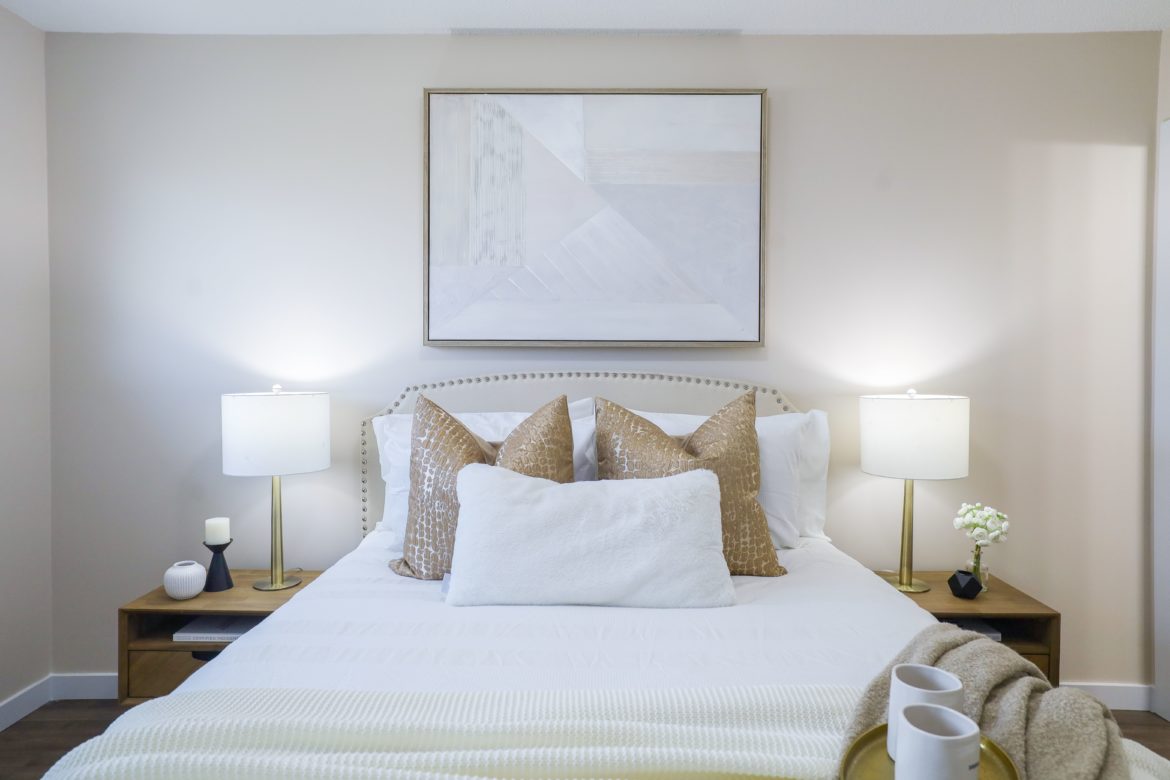
If you can put together a great outfit, you already have the skills to style a beautiful room. Think of your home as your wardrobe – the foundations are the basics, the accessories add personality and the finishing touches are what make the whole look feel intentional.
Getting dressed is, in many ways, a form of styling. You start with the essentials, add layers, play with proportion, introduce texture and finish with the details that make the look feel like you. Your home deserves the same approach.
Instead of asking, “What does this room need?”, try asking, “What would I wear if this room were an outfit?” Suddenly, decorating becomes less about following rules and more about developing a point of view.
Start with the basics
Every great outfit needs a foundation. Think a classic pair of trousers, a simple shirt or the perfect little black dress. Your room needs its own version of wardrobe staples.
These are the larger, harder-to-change elements – your sofa, bed, dining table, flooring, curtains or main cabinetry. Choose pieces that are versatile enough to work with your evolving taste.
If your foundation is relatively neutral, you have more freedom to change the accessories around it. Much like a great pair of black trousers, a well-chosen neutral sofa can take you almost anywhere.
Choose your colour palette like you choose an outfit
Most of us instinctively understand which colours work together when we’re getting dressed. Apply the same thinking to your home.
Rather than choosing every colour you love, select a considered palette of around three to five shades. You might start with a dominant neutral, introduce a secondary colour and then add one or two accent shades.
For example, cream, chocolate brown and black create a sophisticated foundation, while burgundy or olive can be introduced through cushions, artwork or smaller decorative pieces.
And remember: not everything has to match. The most stylish outfits and rooms — usually have a little tension.
Play with texture
Texture is the equivalent of layering an outfit.
Imagine wearing a silk blouse with tailored trousers, a leather bag and suede shoes. Nothing necessarily screams for attention, but together, the different textures create depth.
Do the same at home.
Pair linen with velvet, wood with glass, boucle with leather or woven baskets with polished surfaces. A room made entirely from one texture can feel flat, just as an outfit made entirely from the same fabric can feel predictable.
Texture is particularly useful when you’re working with a restrained colour palette. Different finishes give the room visual interest without requiring lots of colour.
Consider proportion
One of the easiest ways to make an outfit feel polished is to play with proportion. An oversized blazer works because it contrasts with something more streamlined underneath. The same principle applies to interiors.
Don’t make every piece in a room the same size.
Pair a generous sofa with a slim side table. Hang an oversized artwork above a smaller console. Place a substantial lamp on a delicate bedside table.
The contrast creates balance and prevents the room from looking like everything was bought as part of the same set.
Add your statement piece
Every good outfit usually has something: a fabulous coat, statement earrings, a great pair of shoes or an unexpectedly brilliant handbag.
Your room needs one, too.
It could be an oversized piece of art, a sculptural chair, an unusual mirror, a dramatic light fixture or even a beautifully designed coffee table.
The trick is not to make everything a statement. If every piece is competing for attention, nothing feels special.
Choose your hero and let the supporting pieces play their part.
Accessorise, but don’t overdo it
This is where a room really starts to feel personal.
Books, candles, ceramics, photographs, flowers, trays and decorative objects are the equivalent of jewellery and accessories. They’re the details that tell people something about the person who lives there.
But just as you wouldn’t wear every piece of jewellery you own at once, you don’t need to display every beautiful object you’ve collected.
Leave some breathing room.
A beautifully styled shelf isn’t necessarily one that is completely full. Negative space allows your favourite pieces to stand out.
Don’t forget the shoes
Every outfit needs something to ground it. In a room, that job often belongs to the floor.
A rug can completely change the proportions and atmosphere of a space, bringing furniture together and adding warmth and texture.
Think about the rug as the shoes of your room: it doesn’t necessarily need to be the first thing you notice, but it should make everything else look better.
Finish with fragrance
No outfit is quite complete without perfume. And no home is quite complete without scent.
A candle, diffuser or room spray can become the invisible finishing layer of your space.
Think about the mood you want to create. Woody and smoky notes can make a living room feel warm and cocooning, while citrus, floral or green notes can make a space feel lighter and fresher.
It’s the interior equivalent of your signature fragrance: you might not immediately see it, but you notice when it’s missing.
The final mirror check
Before you leave the house, you probably look in the mirror and ask yourself whether everything works together.
Do the same with a room.
Stand back. Look at it as a whole rather than focusing on individual pieces.
Is there too much of one colour? Does everything feel the same height? Is there enough texture? Does the room feel too busy? Is there something missing — or perhaps something that needs to be removed?
Sometimes styling a room isn’t about adding another beautiful object. It’s about taking one away.
The most important rule? Make it feel like you
The best-dressed women aren’t necessarily wearing the most expensive clothes. They’re the ones who understand what works for them.
Your home is no different.
You don’t need to recreate someone else’s living room or follow every interior trend. Start with what you love, understand your proportions, experiment with texture and colour, and allow your personality to lead.
Think of your home as your most permanent outfit.
Dress it accordingly.
ALSO SEE:
Featured Image: Pexels