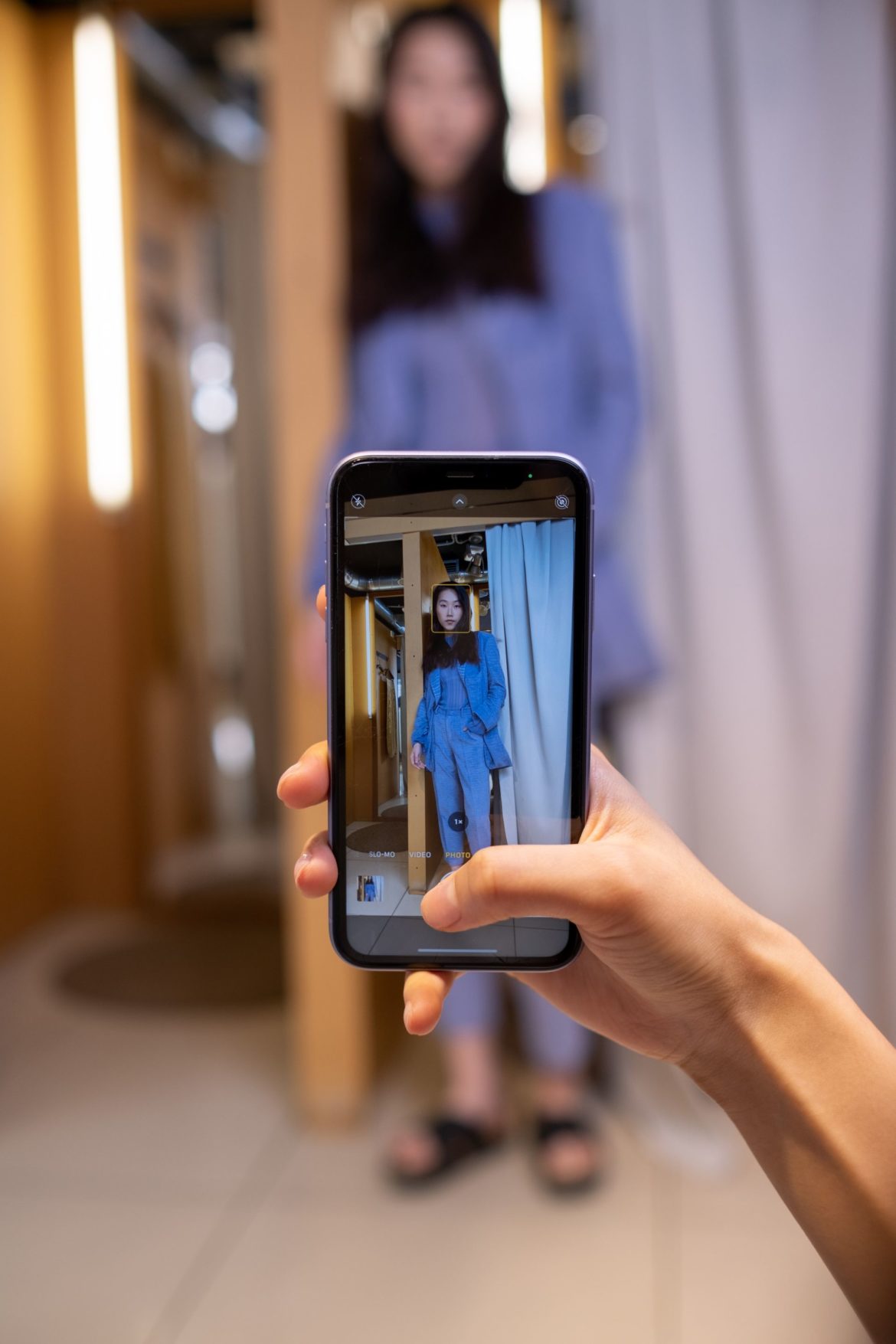
The premise sounds straightforwardly useful. Upload a photo of yourself, place a garment on your digital body, and decide before buying whether the piece actually works on you. Fewer returns, less waste, more confidence at the checkout. It is the kind of technology that arrives with a genuinely logical case.
But there is a growing body of user experience that complicates this picture significantly. Women who have used virtual try-on tools embedded in major fashion retail platforms are reporting that the image returned to them is not entirely their own. Waists are narrower. Limbs are smoother. Proportions have shifted in directions that have nothing to do with how the garment would actually sit on their body. The tool is not failing. It is doing precisely what it was designed to do, and that is, arguably, the most uncomfortable part.
How the tools work and where they go wrong
Major fashion platforms have embedded AI try-on tools as part of a wider shift towards digital fitting rooms. The commercial logic is clear: online clothing returns in some markets account for between 30 and 40 percent of all fashion purchases, and the environmental cost of that return cycle, in transport, processing and waste, is substantial. If customers can see how a garment actually looks on their body before buying, the theory goes, they might choose more accurately and return less often.
In practice, the tools work by generating a digital version of the user’s body based on their uploaded photograph, then layering the garment over it. When limbs are obscured, when clothing overlaps in complex ways, or when the image requires the system to reconstruct a body part it cannot clearly read, the AI fills in the gaps itself. The reconstruction draws on the data it was trained on, and fashion technology, like the broader fashion industry, has a well-documented history of generating imagery that skews toward narrow, standardised body types.
The result is that when the AI smooths an arm, narrows a waist or subtly reconstructs a hip line, it is not malfunctioning. It is reproducing the aesthetic values of the data it learned from: predominantly thin, predominantly young, predominantly one shape. The edit feels plausible precisely because it begins with a photograph of the actual user. It is not a model body superimposed. It is close enough to your own body to feel real, and edited just enough to feel like a better version of it.
Pexels
The science behind the harm
This matters because of what research has established about the relationship between altered body imagery and body satisfaction. A review published in Adolescent Research Review examined dozens of studies on social media exposure and body image, finding that repeated exposure to idealised, manipulated imagery consistently increased body dissatisfaction among young women. Individual studies within this body of research found that teenage girls shown retouched images reported lower body image than those shown unedited versions, and that exposure to thin-ideal imagery lowered appearance satisfaction regardless of how brief the exposure was.
The specific mechanism of AI try-on tools adds a layer that social media imagery does not. When the idealised body in the image is not a model or an influencer but an edited version of your own photograph, the psychological effect is different. Fashion historian Emma McClendon has described this shift as one of proximity: the manipulation is no longer in images of other people that you consume. It is applied directly to your own image, in real time, on your own device.
An old problem in new form
The fashion industry’s relationship with body image is not new. Vanity sizing, in which garment measurements are enlarged while label sizes remain small, has existed for decades. Retouched magazine imagery predates digital media by several generations. What has changed is the directness of the technology and the specificity of its application to individual bodies at the point of purchase.
For plus-size and non-standard body shoppers in particular, the experience of an AI tool narrowing and smoothing their body before returning a result can read as something beyond a technical glitch. It can feel like a confirmation, encoded in software, that the body they have is not the body the platform was designed to accommodate.
What protection looks like
The responses to this problem, where they exist at all, are mostly individual rather than structural. Discussions about technology regulation for AI try-on tools are largely absent from mainstream policy conversations. Comparisons are sometimes drawn to TikTok’s ban on beauty filters for users under 18, but the structural issue here is less about age gates and more about the values embedded in the training data itself.
The question worth sitting with is not whether AI can make shopping more convenient. It probably can. The question is whether the version of convenience being built is one that requires women to see an edited version of themselves in order to feel confident buying clothes. If the try-on tool works, but only by showing you a slimmer body wearing the outfit, it has not actually solved the problem it promised to solve. It has simply moved the moment of disappointment from the fitting room to the front door.
ALSO SEE:
5 fashion hacks Fashion Editors swear by to look effortlessly chic
Featured Image: Pexels