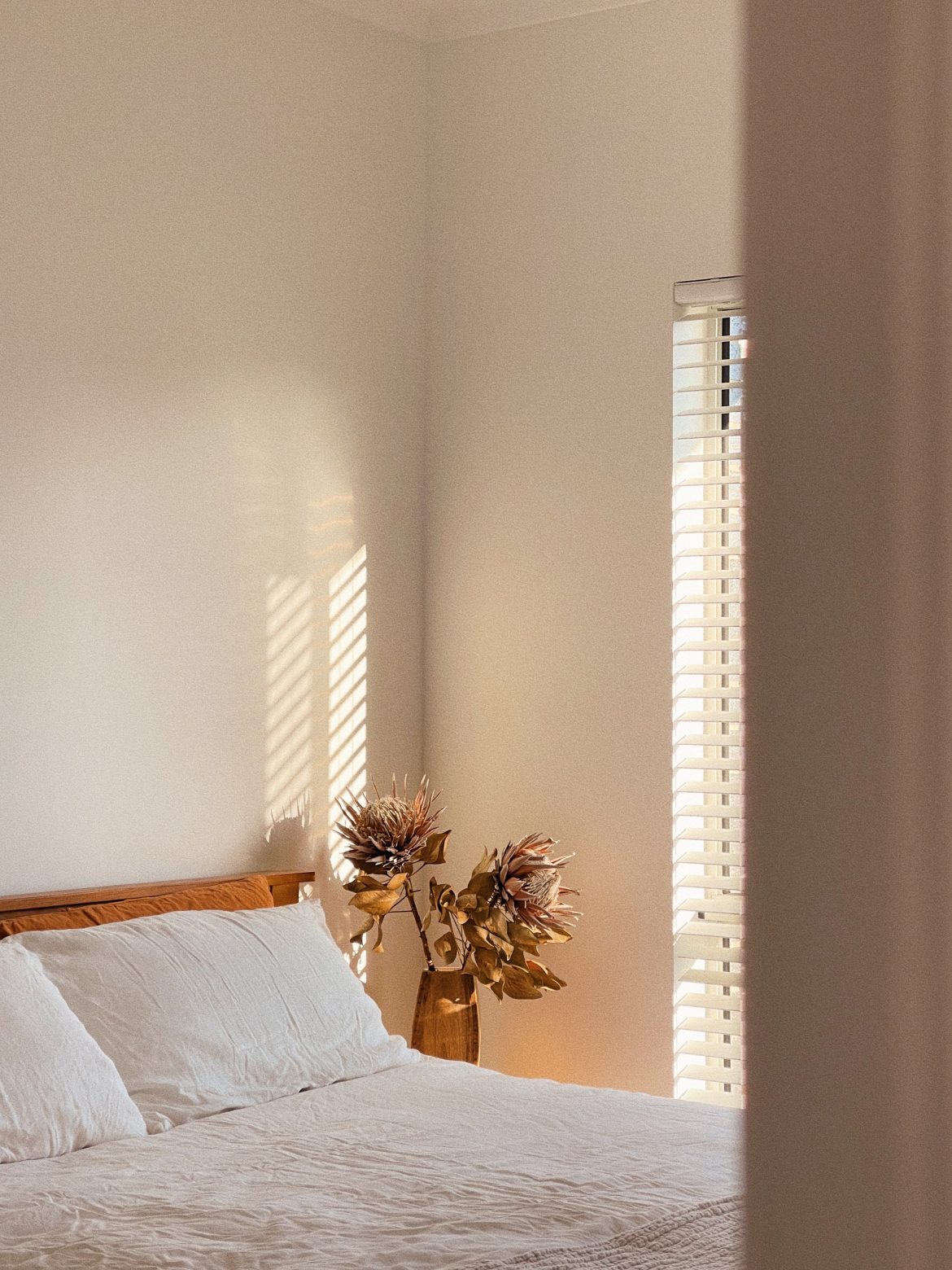
Your bedroom shouldn’t just look good for social media — it should regulate your nervous system.
In a world of constant notifications, overstimulation and chronic stress, your bedroom has the potential to become a cortisol-lowering sanctuary. And no, that doesn’t mean it has to be entirely beige or look like a minimalist showroom. It means designing intentionally — with your hormones in mind.
Here’s how to create a bedroom that genuinely helps your body switch from fight-or-flight to rest-and-repair.
Start with your nervous-system-friendly colour palette
Instead, opt for soft sage greens, muted blues, warm creams and taupes, dusty rose or clay tones.
These colours sit in the mid-to-low saturation range, which helps signal safety and calm to the brain.
This doesn’t mean your room must be boring. Texture — boucle, linen, cotton, wood — adds depth without overstimulation. Think soft life, not sterile.
Lower the lighting (Literally)
Your bedroom lighting should mimic sunset — warm, dim and layered.
Prioritise warm bulbs (2700K or lower), bedside lamps instead of overhead lights, wall sconces for soft glow and candles (real or LED) for wind-down rituals.
Light is one of the biggest regulators of circadian rhythm. When lighting softens, melatonin rises and cortisol drops naturally.
Declutter the visual noise
Clutter is not just visual — it’s cognitive.
Every visible pile of laundry or chaotic surface is an unfinished task in your brain. That subtle “I should…” keeps stress hormones slightly elevated.
Focus on clear bedside tables (keep only essentials), hidden storage baskets, a dedicated laundry hamper and no work-related items in sight.
Your bedroom should not double as your office. If it must, create physical separation — even a screen or curtain helps signal boundaries.
Upgrade your bedding (This is hormonal)
Breathable, natural fabrics like:
- 100% cotton
- Linen
- Bamboo
These can help regulate body temperature and prevent nighttime stress spikes.
Layer your bed intentionally:
- Fitted sheet
- Flat sheet
- Duvet
- Throw
The psychological cue of a “made bed” also promotes a sense of control and order — something your nervous system loves.
Remove micro-stressors
Sometimes cortisol stays high because of tiny irritations. Audit your room for flashing charger lights, streetlight glare (invest in blackout curtains), constant notification sounds and synthetic fragrances that overwhelm.
If your phone is your alarm, consider moving it further away or switching to an analogue clock. The goal is fewer subconscious alerts.
Add one ritual corner
Cortisol lowers when your brain associates a space with safety and repetition.
Create a small ritual corner that could be a chair for reading, a journal and pen, a small plant and a soft blanket.
This becomes your wind-down cue. Over time, just sitting there tells your body: we are safe, we are slowing down.
Let air and nature in
Fresh air lowers stress markers. Natural light in the morning helps regulate your cortisol awakening response — the natural spike that should happen shortly after waking.
Add:
- A plant (even one)
- Sheer curtains to soften daylight
- Open windows when possible
Nature cues the body out of survival mode.
The real secret: Emotional safety
A cortisol-lowering bedroom isn’t about trends. It’s about how the room makes you feel.
Does it feel calm?
Does it feel like yours?
Does it feel uncluttered, soft, and safe?
For someone stepping into her softer era — building calm, managing anxiety, wanting to feel grounded — your bedroom is not just décor. It’s hormone support.
Design it like your peace depends on it. Because biologically, it does.
ALSO SEE:
Featured Image: DupePhoto