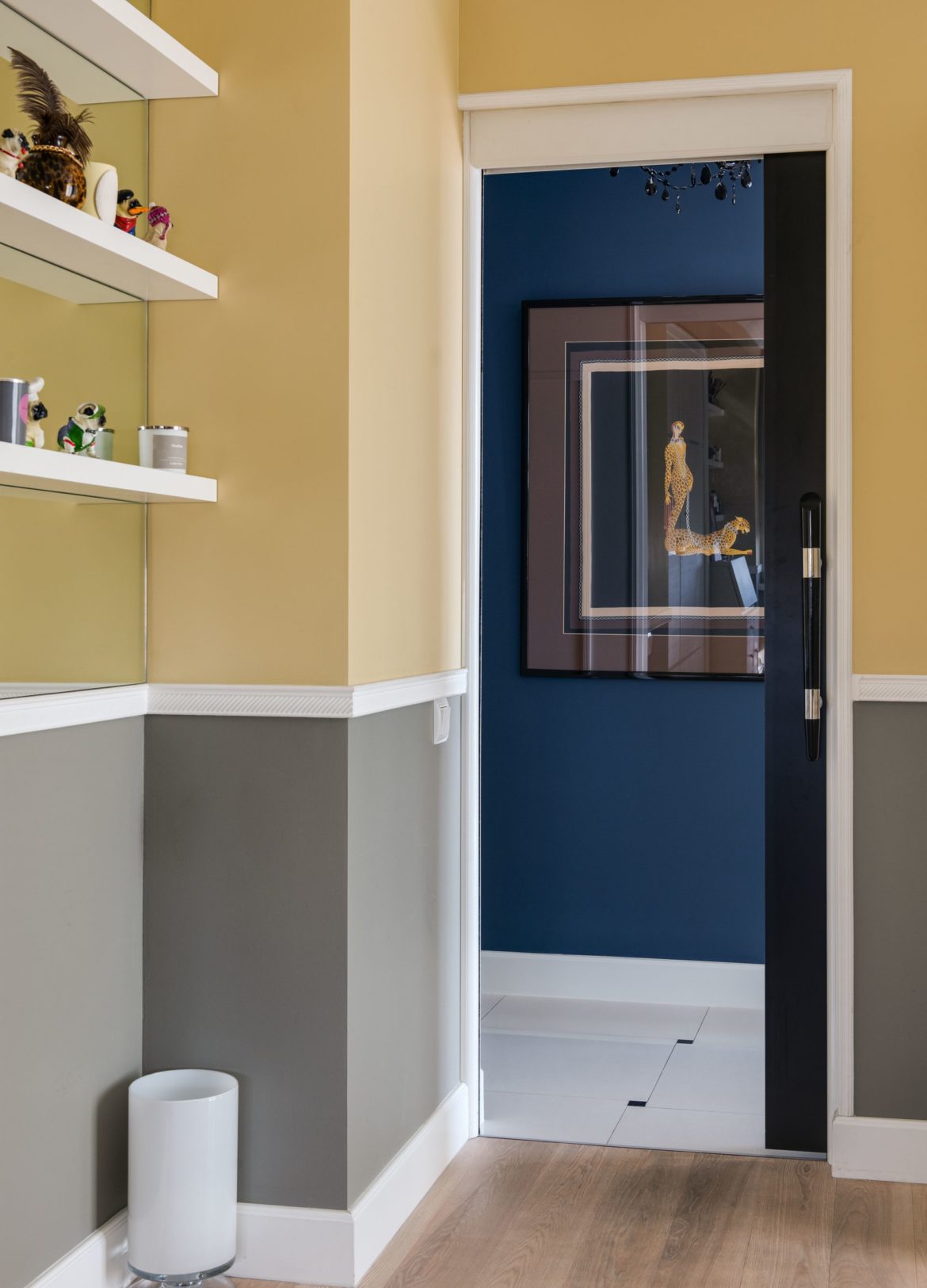
A pocket door is not a statement piece. It is a solution, which is exactly why it tends to work best when it is chosen for a specific space problem rather than as a general stylistic preference. In the right location, a door that disappears into the wall rather than swinging into a room changes the functionality of that space in a way that is hard to achieve by any other means. Here is where to consider one.
The ensuite bathroom
The ensuite is the classic pocket door application, and for good reason. Bathroom space in most homes is tight, and a standard hinged door requires clearance that often forces awkward compromises in the layout, particularly where there is a vanity, towel rail or basin near the door frame. A pocket door removes that constraint entirely, freeing up the full footprint of the room and allowing fixtures to be positioned optimally rather than around the door’s swing. It is also the kind of detail that reads as considered and well-designed in a way that is immediately obvious once you notice it.
The scullery or pantry
A scullery or pantry concealed behind a pocket door is one of the most satisfying small renovations in a kitchen. Open when in use, the workspace and storage are fully accessible. Slide the door shut, and the kitchen looks clean, complete and organised regardless of what’s happening behind it. This is the solution that solves the specific problem of open-plan kitchens where the mess of daily food preparation is visible from the dining or living space. It also solves the problem of pantry doors that swing into traffic paths.
The home office nook
A home office carved from a corner of a bedroom, spare room or living area benefits enormously from a pocket door. During work hours, it provides enough acoustic separation to manage calls and concentrated work without the full isolation of a closed room. Outside work hours, it slides back, and the space reads as part of the whole. For households where working from home is permanent, this level of flexibility, genuinely open versus genuinely closed, is significantly more useful than simply leaving the space open.
Between the kitchen and the dining room
In a semi-open plan home where the kitchen and dining room are adjacent but not fully merged, a pocket door between the two spaces offers exactly the flexibility that a standard hinged door makes impractical. Fully open for relaxed evenings when the cooking and the conversation flow together; closed during formal dinners where the kitchen noise and post-cooking chaos are best kept separate. The transition between modes takes a second and does not require negotiating a door swinging into anyone.
Awkward corridor doors
Any door at the end of a narrow corridor, or opening into a space so tight that the swing creates constant friction with adjacent furniture, is a candidate for a pocket door. The savings in usable floor space in these locations can be more significant than they appear: a standard door typically requires a clearance arc of roughly 80 centimetres, which in a corridor or tight room represents a meaningful portion of the total space.
The linen cupboard or laundry room
Laundry rooms and linen cupboards are typically fitted with doors that are opened, held awkwardly while you retrieve or deposit something, and then closed again. A pocket door makes this routine considerably less irritating and allows the full width of the opening to be used without the door getting in the way. In a hallway where a laundry room door would otherwise swing into the passage, the benefit is both practical and spatial.
Children’s rooms connected to a play area
Where a bedroom connects to a play area, study room or small sitting space, a pocket door allows parents to leave the spaces open during the day and separate them easily at bedtime or naptime without the drama of a closing door. It also removes the safety concern of small fingers and hinged door edges in high-traffic family spaces.
ALSO SEE:
Featured Image: Pexels