
For years, we called it Polycystic Ovary Syndrome. There’s just one rather glaring problem with that name: this condition has never simply been about ovarian cysts. In May this year, medicine finally acknowledged that. PCOS was officially renamed Polyendocrine Metabolic Ovarian Syndrome, or PMOS, recognising its much broader endocrine and metabolic nature.
When this news reached my uncle, Dr Russell Cooper, his response was essentially, ‘we’re getting closer’.
Dr Cooper, a medical doctor and Life Source’s Medical Director, believes even “ovarian” may ultimately prove too limiting. He has treated men with similar endocrine and metabolic patterns and has long believed there may be a male expression of the condition. It’s an unconventional view and not an established diagnosis, although researchers have been investigating the idea of a male PCOS equivalent for years.
So what exactly are we dealing with?
I wish I’d understood that question when I was diagnosed in my twenties.
At 26 or 27, after losing my gran and going through an awful breakup, I threw myself into exercise. I’d arrive at the gym around eight and sometimes leave at three. I ran 10 kilometres, trained, worked, sometimes trained again, sat in the sauna and did hot yoga. I was barely eating.
Then my period disappeared.
My hair fell out. My skin erupted in painful acne. I became exhausted, ravenously hungry and started gaining weight rapidly. Eventually an endocrinologist diagnosed me with PCOS and told me my insulin was extremely high and that I was prediabetic.
I left her office hungry and walked into the supermarket downstairs. Suddenly I was terrified of food. Fruit contained sugar. Bread meant carbohydrates. What was in the sauce on the chicken? I stood surrounded by food and genuinely didn’t know what I was allowed to eat.
My mental health deteriorated badly. I was anxious and depressed. Meanwhile, I was working on television just as HD arrived. Spectacular timing when you’re experiencing severe hormonal acne! People online called me “pizza face” and “dirty face”. I was also working with Nike, trying to represent health and athleticism while privately feeling anything but healthy.
I couldn’t understand how all of this belonged to the same condition. What did my appetite have to do with my ovaries? My insulin? My skin? My energy? My mental health?
Then my dad told me to call Uncle Russell.
Dr Cooper asked for my blood results and explained PCOS very differently. He taught me that its expression can vary enormously and that multiple systems and pathways can be involved and influence one another.
That’s also why two people can experience it so differently. One may first notice irregular periods and acne. Another may be battling relentless cravings, fatigue or weight changes. For someone else, it might be hair loss or difficulty conceiving that finally leads them to investigate.
Suddenly there was a bigger picture.
Dr Cooper developed a comprehensive nutritional protocol for me. Some of what I needed wasn’t available in South Africa, so while travelling for television work I’d order products to whichever hotel I was staying in. At one stage I was spending around R10,000 a month.
Then things started changing.
My appetite and energy were the first differences I noticed. The relentless cravings settled. My hair stopped falling out and started growing back. My skin improved. My periods became more regular and far less painful.
I kept thinking: how is an ordinary woman supposed to access all of this?
The answer became, “We may as well make it ourselves.”
Working with Dr Cooper, we took the thinking behind the complicated, expensive protocol I’d been following and developed Life Source PCOS Support.
PCOS never felt like one thing happening in one part of my body, so we didn’t want to formulate for it as though it was.
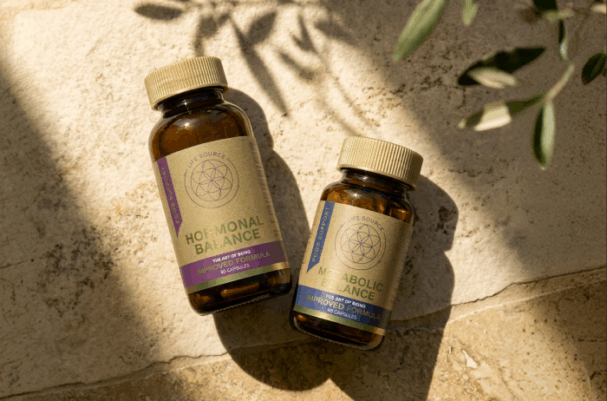
That’s why our system has two complementary formulations: Metabolic Balance and Hormonal Balance. Metabolic Balance includes targeted inositols alongside ingredients selected with metabolic pathways in mind, while Hormonal Balance takes a different approach to the hormonal and inflammatory side of the picture.
There’s another important difference in the way Dr Cooper designed the protocol: *we don’t take Hormonal Balance in exactly the same way throughout the menstrual cycle.*
The hormonal environment of a menstrual cycle isn’t static. Oestrogen and progesterone fall before menstruation and are low in the early part of the cycle, before oestrogen begins rising again towards ovulation. Dr Cooper believes it makes little sense to formulate around female hormones and then ignore those physiological changes when deciding how the formula should be taken.
That’s why Hormonal Balance is stopped during the bleed and reintroduced afterwards according to our dosing protocol. The decision is biological rather than ceremonial: different phases of the cycle have different hormonal environments, and the herbs and nutrients a woman takes should be considered in that context.
I think women deserve to know this more broadly. “Natural” doesn’t automatically mean appropriate every day of the month, and a herb that influences hormonal pathways shouldn’t be treated as though the menstrual cycle is irrelevant. More isn’t necessarily better, and timing does matter.
Interestingly, the new name PMOS now formally recognises two areas that were already central to our approach: endocrine and metabolic health.
Dr Cooper believes the picture extends further still. Research continues to investigate inflammation, the body’s stress response and cortisol, and cellular energy pathways such as AMPK, which helps cells sense and regulate energy. These areas have formed part of the broader biological picture behind the way Dr Cooper thinks about the condition and our formulations.
That thinking also determines what goes into the bottles.
We could make Life Source cheaper by reducing quantities or compromising on the quality of ingredients we source. We choose not to. Dr Cooper formulates around what he believes belongs in the system and in meaningful amounts, and we work backwards from there. That inevitably affects what it costs to produce, but having once spent a fortune trying to get well myself, I don’t take that decision lightly. Every ingredient has had to earn its place.
Comprehensive, to us, has never meant putting everything into a bottle. It means being deliberate about what goes in, what stays out and why.
Nearly ten years after launching Life Source, I find it extraordinary that medicine has changed the name of the condition in a direction that reflects so much of what Dr Cooper was teaching me back then. I suspect both the name and our understanding of the condition will continue to evolve.
Mine certainly has.
At 38, health is less about what my body looks like and more about what it allows me to do. I ride my horses, rebound with my mum, walk my dogs, work, cook for my family and spend time with my husband. I still love feeling strong. I simply don’t feel the need to prove it quite so relentlessly anymore.
After spending years fighting my body, I’m enjoying being a little softer with it.
~ Life Source Co-Founder, Lalla Hirayama
Discover the thinking behind Life Source PCOS Support, its Metabolic Balance and Hormonal Balance formulations, and the ingredients Dr Cooper selected for each here.
ALSO SEE:
Featured Image: Supplied