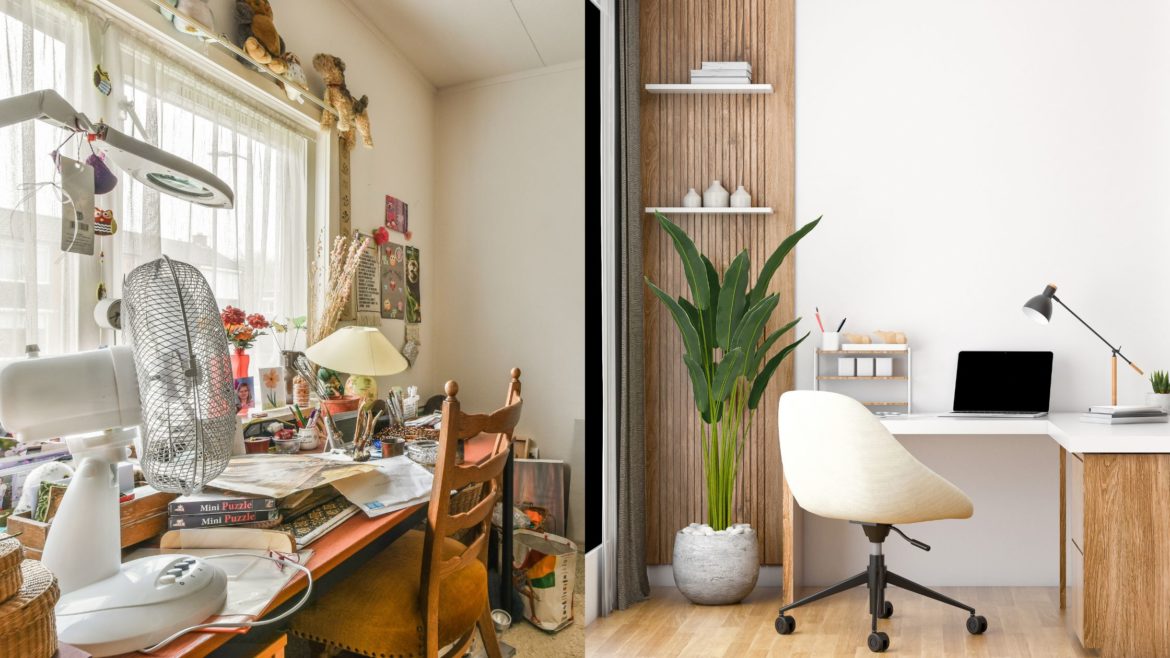
Two schools of thought currently dominate the conversation about how we should live. On one side, the minimal: clear surfaces, neutral tones, nothing on the walls that wasn’t placed there with careful deliberation. On the other, the cluttercore: shelves packed with objects that carry history, layered textiles, collections that resist containment. Both have passionate advocates. And both, it turns out, have something to teach.
What minimalism actually offers
Minimalism is often misunderstood as a rejection of personality. Done well, it’s anything but. The discipline of minimalism is that it forces you to be precise about what you truly value. Each piece that makes it into a minimal space has had to earn its place, and the absence of visual noise means that the objects and art that are present carry more weight.
From a practical standpoint, minimalism is easier to clean, less visually stimulating in a way some people find genuinely restful, and tends to look polished regardless of the size of the space. In smaller South African flats, a more minimal approach can make a room feel considerably larger than its actual footprint.
What cluttercore offers in return
Cluttercore offers warmth, personality and a sense of accumulated life that minimalism can struggle to project. A home layered with objects, art, plants, books and textiles tells a story about the person who lives there in a way that a pared-back space rarely does.
There is also something psychologically significant about surrounding yourself with meaningful objects. The connection to memory and identity that comes from seeing the things you love around you can contribute to a sense of comfort and rootedness that an empty surface cannot replicate.
The honest case for each
Minimalism works best for people who genuinely find visual complexity stressful. If a pile of objects on a surface makes you feel anxious rather than at home, minimalism isn’t a trend you’re following: it’s the correct way for you to live. It also works well for people who move frequently or prefer to invest their attention in experiences rather than objects.
Cluttercore works best for people who are collectors by nature, who find that their home needs to reflect their personality actively rather than passively. It works for people who have accumulated things with genuine meaning and want to find ways to honour that.
The case for the middle ground
Most people, if they’re honest, don’t belong cleanly to either camp. The homes that tend to feel most successful are those that borrow from both philosophies: the intentionality of minimalism applied to a curated maximalist collection. Objects grouped with thought. Negative space is deliberately built into busier arrangements.
This might mean one wall of the house that is densely layered with art and shelving, while the adjacent walls are clean and simple. Or a living room where every surface is used, but each arrangement is composed with care.
Which is better for smaller homes?
In smaller spaces, the case for minimalism is often pragmatic. Less stuff is genuinely easier to manage in a compact flat. But the solution isn’t necessarily a pure minimal approach: it’s being more deliberate about which objects and collections you allow in and how you display them.
The cluttercore principle of grouping things that share a connection works just as well in a small space as a large one. The constraint is simply that the editing has to be tighter.
The answer
Neither approach is objectively superior. The better question is which one reflects how you actually want to live, and whether your current home is helping or hindering that. A cluttercore home that’s simply full of things accumulated without intention is just a messy home. A minimal home where everything meaningful has been packed away in the name of a trend is an uncomfortable one.
The best homes are those designed around the people who live in them. Sometimes that’s spare and clean. Sometimes it’s full and layered. Often, it’s somewhere between.
ALSO SEE:
Warm minimalism: How to keep your space cosy without overdecorating
Featured Image: Canva Pro