
Some mornings, an outfit just works. The colours make sense together, nothing feels too busy or too flat, and you leave the house feeling like you made a deliberate choice rather than a hopeful one. Other mornings, the same wardrobe produces something that looks fine on individual hangers but inexplicably wrong once it is all on. The 3-colour rule is the styling principle that explains the difference, and once you understand it, getting dressed becomes considerably less frustrating.
The idea is simple: limit each outfit to a maximum of three colours. A dominant, a secondary and an accent. The proportions matter, and so do the relationships between the colours, but the basic principle is about restraint. Three well-chosen colours produce a cohesive, intentional look. More than three tends to produce visual noise, where no single element can hold the eye and the overall impression is cluttered rather than considered.
The 60-30-10 ratio
The three colours do not share equal space. The most useful way to think about the proportions is the 60-30-10 split: your dominant colour makes up roughly sixty per cent of the outfit, your secondary takes about thirty per cent, and your accent provides the remaining ten.
In practice, this might look like camel trousers and a matching coat as the dominant, a cream knit as the secondary, and tan leather boots or a burgundy bag as the accent. The dominant grounds the outfit, the secondary adds depth, and the accent introduces interest without overwhelming. The accent is often the most enjoyable part to choose because it is where personality enters the equation: the same camel-and-cream base looks entirely different with a rust accent versus a cobalt one.
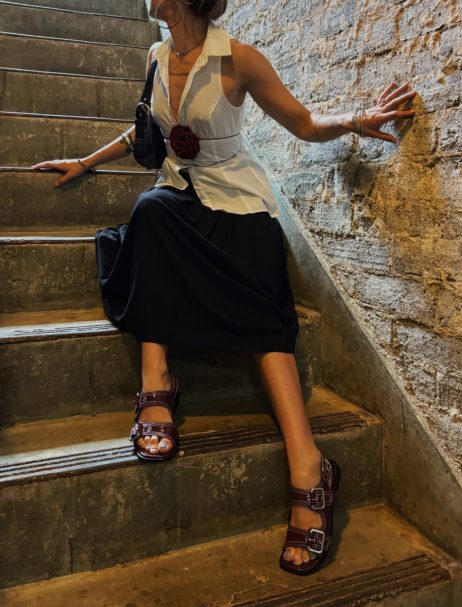
Dupe Photo
Black and white are neutrals, not colours
One of the most freeing aspects of the 3-colour rule is that black and white are widely regarded as neutrals rather than colours within this framework. They do not count against your three. This means a white shirt, black trousers and tan boots is technically a one-colour outfit with two neutral anchors, and you have two full colour slots still available if you want them. A camel blazer and a red lip over that base produces a three-colour outfit by most interpretations.
This also means that if you predominantly dress in black, white or neutral tones, the rule works as an invitation to introduce colour in a controlled and deliberate way. One strong accent, perhaps a cobalt bag, emerald earrings, or a rust scarf, against an otherwise neutral outfit is one of the most reliable ways to look polished without effort.
How to work with prints and patterns
Prints do not break the rule; they just require a slightly different approach. When a printed piece is the starting point of an outfit, pull two or three of its dominant colours and use those to guide the rest of your choices. A floral blouse with navy, cream and dusty rose as its main tones becomes the colour palette for the entire outfit: navy trousers, cream shoes, a rose-toned bag. The print has already done the colour coordination work for you, and matching from within it rather than adding new colours keeps everything coherent.
The same logic applies to bold patterns: stripes, checks, geometric prints. Identify the colours that make up the pattern and treat those as your palette. You are not limited to three separate items; you are limited to three colours across everything, including the tones within a print.
When to break the rule
Rules in fashion exist to be understood, not slavishly followed. The 3-colour rule is most useful as a starting point when you are unsure, overwhelmed or getting dressed quickly. Once you understand why it works, which is essentially because limited palettes create visual harmony and let each element breathe, you can depart from it intentionally rather than accidentally.
All-black and all-white outfits break the rule entirely and can be spectacular. Tonal dressing, wearing two or three shades of the same colour, also sidesteps the rule but produces beautifully cohesive results when the textures and silhouettes are varied. Bold colour mixing that breaks the three-colour limit can work brilliantly for specific occasions where maximum impact is the goal. The difference between these intentional departures and an outfit that simply looks too busy is knowing why you are making each choice.
Applying the rule to your existing wardrobe
The most practical way to start using the 3-colour rule is to look at what you already own and identify which colours repeat most across your wardrobe. These are your natural dominants. Then look for the colours that appear less frequently but consistently: these become your reliable secondaries. From there, identify a handful of accent colours, either in accessories, shoes or smaller statement pieces, that sit well alongside your most common combinations.
Most people find they are already working with a loosely consistent palette, they simply have not articulated it. Naming and recognising it makes getting dressed faster and the results more consistent. The 3-colour rule does not require a capsule wardrobe or a colour-coordinated closet. It requires attention to what is already there.
ALSO SEE:
Winter workwear, reimagined – Office looks that feel modern and comfortable
Featured Image: Dupe Photo