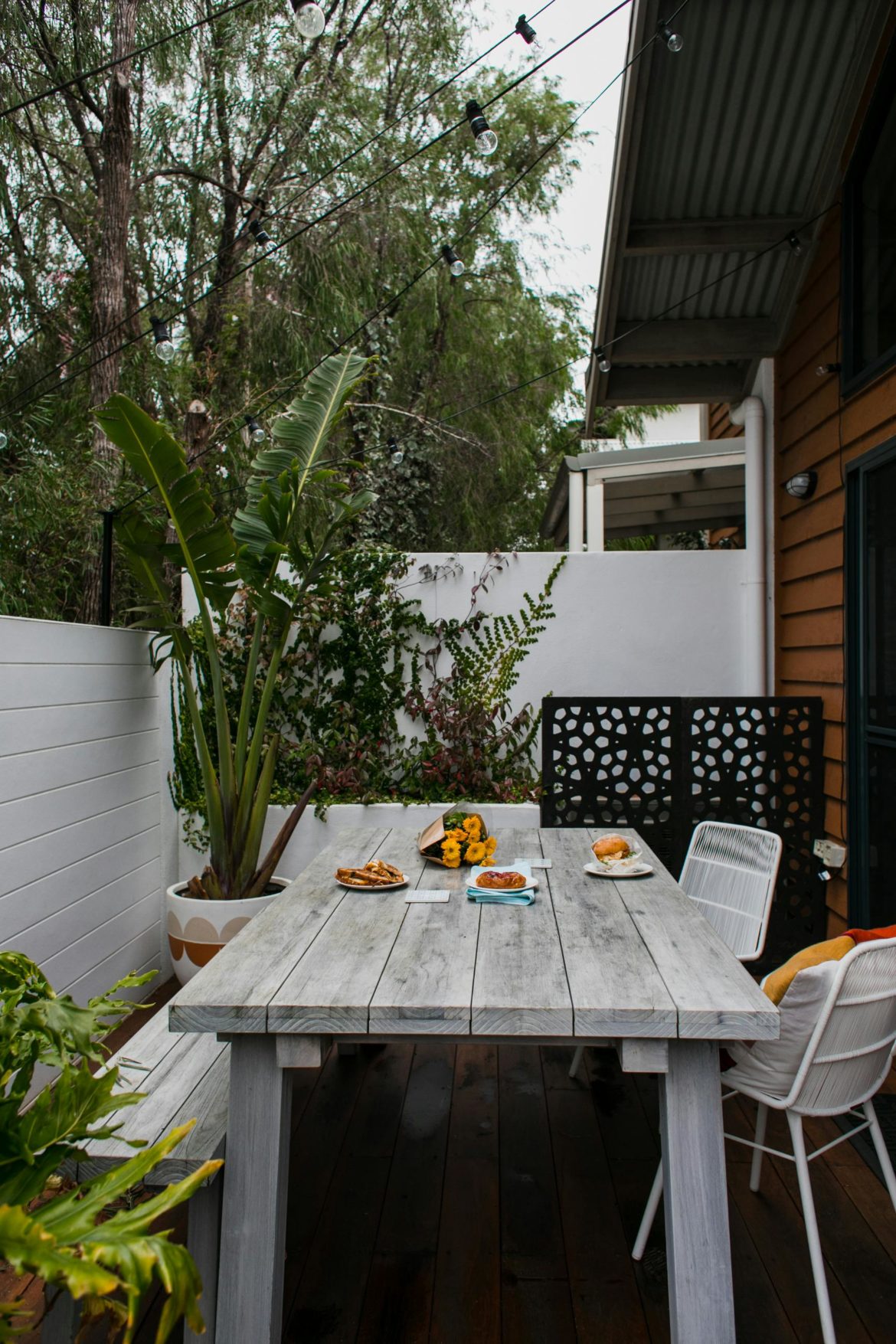
A well-designed outdoor space can do a lot for a home, but even the most carefully considered gardens and patios tend to come with a few unavoidable blights. HVAC condensers, garden hoses, electrical panels and chain-link fencing are rarely part of anyone’s design vision, yet they are part of most people’s reality. The good news is that hiding them, or at least drawing the eye away from them, is more achievable than it might seem.
Here are six practical, design-led approaches that work.
Pexels
Use vertical growers around mechanical units
Air conditioning condensers and HVAC units are among the most common backyard eyesores, and they also happen to be one of the easiest to address. Surrounding the unit with upright-growing plants creates a natural screen that softens the visual impact without restricting the airflow the unit needs to function properly.
Fast-growing evergreen shrubs work particularly well for this purpose. Pittosporum tenuifolium, with its lace-like foliage and year-round coverage, is a popular choice among landscapers for exactly this reason: it provides dense screening while still allowing adequate air circulation around the unit. The key is to avoid planting anything too close or too dense that could impair the condenser’s performance.
Invest in multipurpose planters
Planters are a reliable tool for concealing all manner of outdoor necessities, and the most useful ones do double duty. A planter that also houses and rolls a garden hose, for instance, keeps one of the garden’s more ungainly accessories completely out of sight while still remaining accessible. Options with a trellis attached to the back serve a similar function for taller eyesores, giving climbing plants something to grow against while the structure behind them disappears from view.
Planters on wheels are especially versatile: they can be repositioned as needed and add a layer of flexibility that fixed landscaping cannot.
Install low fencing
When planting is not practical, a simple fence enclosure is an effective alternative. This approach is commonly used to screen off outdoor bins, but it works equally well around HVAC systems and utility areas. The important thing is to keep the fence low enough to avoid impeding the unit’s performance. As a general rule, the top of the fence should sit no higher than around 15 centimetres above the condenser to ensure adequate airflow.
Simple slatted or louvred timber panels are a clean, low-cost solution that blends into most garden styles without demanding much attention of its own.
Cover chain-link fencing with vines
Chain-link fencing presents a specific challenge: it is functional, often necessary, and one of the less attractive features a garden can have. The structure itself, however, is actually ideal for vines. The open weave gives climbing plants plenty of purchase, and as they grow, the metal disappears behind a wall of foliage and, depending on the species, seasonal flowers.
Star jasmine is a particularly good choice for South African gardens: it is hardy and evergreen, grows reliably, and produces small, fragrant white flowers that add decorative value well beyond simple screening. Within a growing season or two, the fence itself becomes barely an afterthought.
Create a garden distraction
Not every eyesore can be fully concealed, and sometimes the more effective strategy is to give the eye something more interesting to land on. A well-placed focal point, positioned between the viewer and the problem area, can shift attention entirely.
The options here are wide-ranging. Striking potted plants, tall architectural shrubs, an ornate garden sculpture or a water feature can all serve as effective distractions. For larger areas, an outdoor kitchen or fire pit creates a genuinely compelling focal point that draws people towards it rather than towards whatever lies behind. The principle is straightforward: when you cannot hide something, make something else more interesting instead.
Build a decorative housing for small fixtures
Electrical panels, external meters and backup batteries are small enough that they are often overlooked as candidates for concealment, yet they are consistently among the least attractive features on the exterior of a home. A simple wooden housing built around the item, designed to look like a decorative birdhouse or garden box with an open front panel for access, provides an elegant solution that requires very little space or material.
The open front design allows the meter to be read and the battery to be maintained without dismantling anything. One important caveat: before building any structure around an external electrical fixture, check local building regulations to confirm that access requirements are met and that no compliance issues arise.
ALSO SEE:
Featured Image: Pexels